


AXING Application Note
AXING headends support the reception of satellite signals via single-cable distribution systems (UNICABLE I and UNICABLE II (JESS) according to EN50494 / EN50607). This allows a headend to be supplied via a single coaxial cable.
The use of single-cable technology significantly reduces cabling efforts. Depending on the installation, the headend can receive satellite signals in various ways:
- Direct connection to a single-cable LNB
- Connection via a single-cable multiswitch
- Connection to a conventional satellite system with a quattro or quad LNB or multiswitch
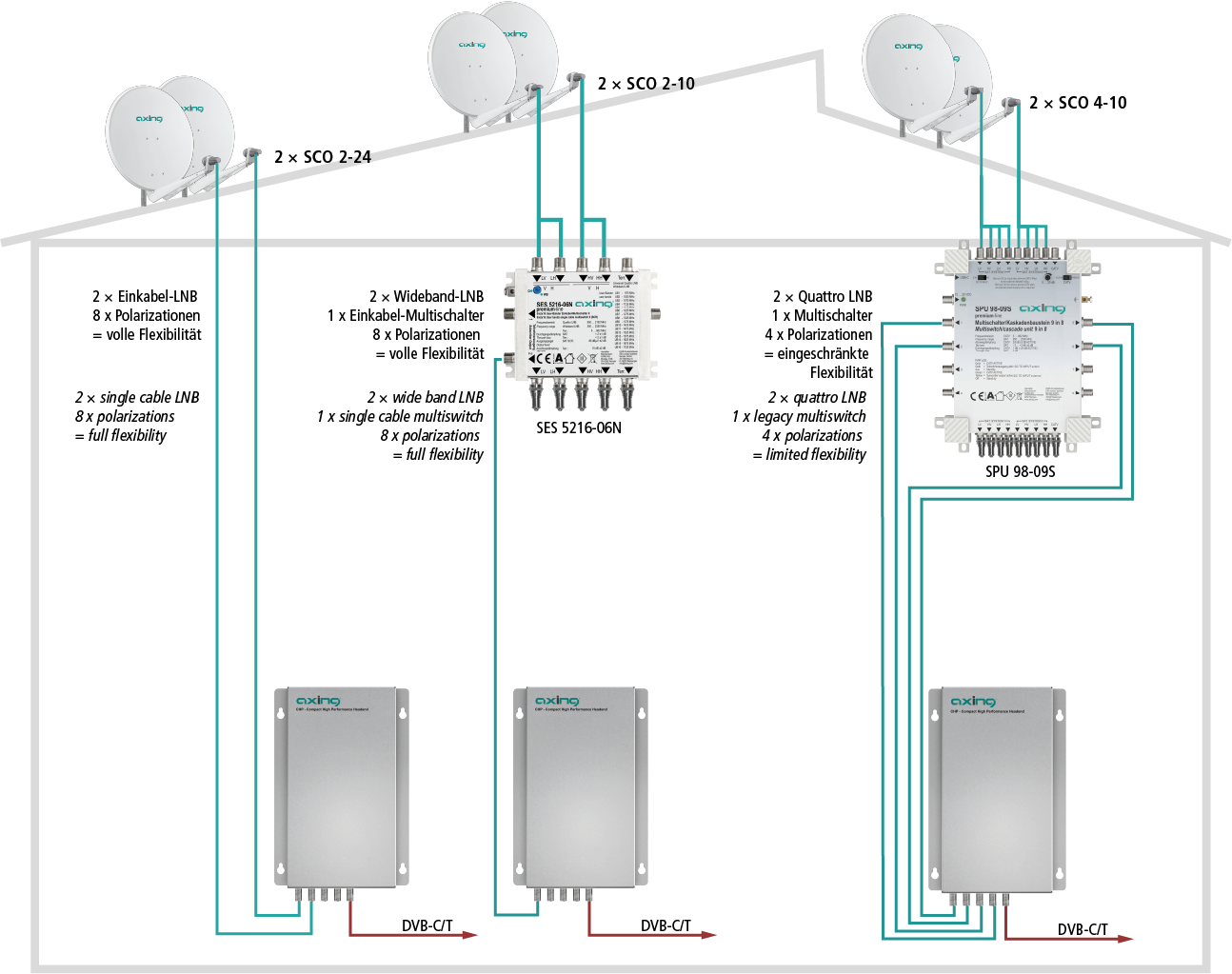
All current AXING headends support single-cable reception. The new MK-C and MK-N headend series particularly benefit from this. They have four SAT inputs and a built‑in switching matrix. In combination with a single-cable system, the headend can be supplied with all available SAT transponders via a single coaxial cable. This enables flexible system planning and reduces installation effort.
Configuration of single-cable reception
The satellite reception parameters are configured in the INITIALISATION menu of the headend user interface. The settings for the single-cable system are made in PHASE 1 – Tuner Configuration. After entering the standard transponder parameters (e.g. frequency and polarisation), only a few additional settings are required. The figure below shows an example configuration.
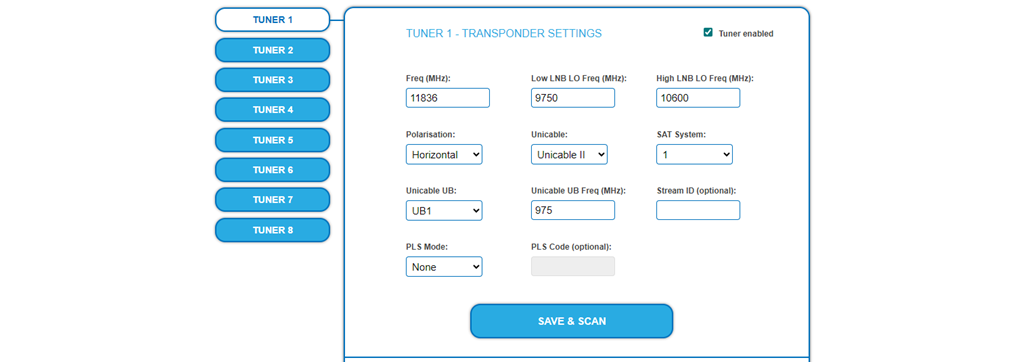
- Select Unicable II as the reception mode
- Select SAT system
- Select Unicable User Band (UB)
- Enter UB frequency according to the frequency list of the used LNB or multiswitch
- Enter desired transponder parameters such as frequency and polarisation
Installation notes
- Each SAT tuner must be assigned its own User Band (UB).
- The configured UB frequency must match exactly the LNB or multiswitch used.
- EN50607 (UNICABLE II) supports up to 32 User Bands
User Band frequency list
| UB | UB Frequency | Used in LNB | Used in multiswitch |
| UB 1 | 975 MHz | SCO 2-24 | SES 5216-06N |
| UB 2 | 1025 MHz | SCO 2-24 | SES 5216-06N |
| UB 3 | 1075 MHz | SCO 2-24 | SES 5216-06N |
| UB 4 | 1125 MHz | SCO 2-24 | SES 5216-06N |
| UB 5 | 1175 MHz | SCO 2-24 | SES 5216-06N |
| UB 6 | 1225 MHz | SCO 2-24 | SES 5216-06N |
| UB 7 | 1275 MHz | SCO 2-24 | SES 5216-06N |
| UB 8 | 1325 MHz | SCO 2-24 | SES 5216-06N |
| UB 9 | 1375 MHz | SCO 2-24 | SES 5216-06N |
| UB 10 | 1425 MHz | SCO 2-24 | SES 5216-06N |
| UB 11 | 1475 MHz | SCO 2-24 | SES 5216-06N |
| UB 12 | 1525 MHz | SCO 2-24 | SES 5216-06N |
| UB 13 | 1575 MHz | SCO 2-24 | SES 5216-06N |
| UB 14 | 1625 MHz | SCO 2-24 | SES 5216-06N |
| UB 15 | 1675 MHz | SCO 2-24 | SES 5216-06N |
| UB 16 | 1725 MHz | SCO 2-24 | SES 5216-06N |
| UB 17 | 1775 MHz | SCO 2-24 | |
| UB 18 | 1825 MHz | SCO 2-24 | |
| UB 19 | 1875 MHz | SCO 2-24 | |
| UB 20 | 1925 MHz | SCO 2-24 | |
| UB 21 | 1975 MHz | SCO 2-24 | |
| UB 22 | 2025 MHz | SCO 2-24 | |
| UB 23 | 2075 MHz | SCO 2-24 | |
| UB 24 | 2125 MHz | SCO 2-24 |