


Ultra Compact Headend


Developed by AXING and manufactured in the EU, the MK 8-1xC reflects our commitment to reliable engineering, seamless integration, and European quality standards – while offering a professional feature set at a highly competitive price.
Vorteile auf einen Blick:
-
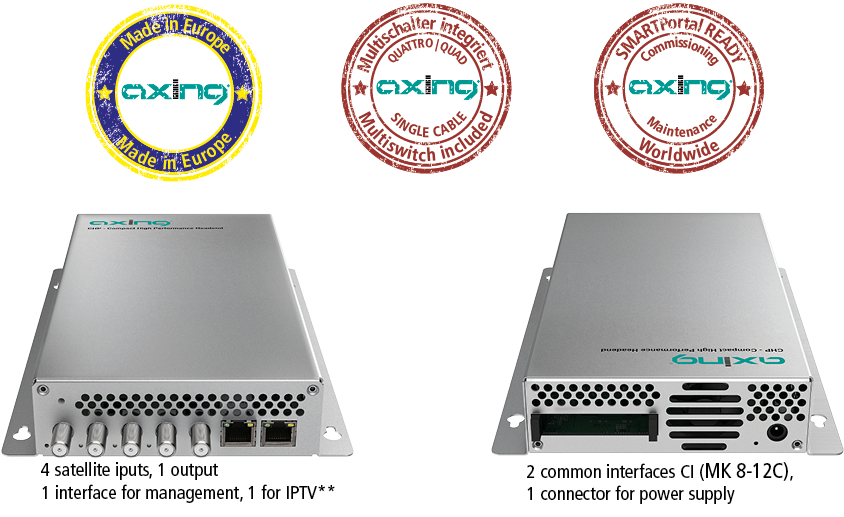
4 inputs for Quattro, Quad or Single cable LNB with integrated multiswitch, single cable reception I and II possible
-
8 × DVB-S/S2/S2X in 8 × DVB-C/-T
-
Alternative IPTV output in Q4/2026 available
-
Suitable for AXING SMARTPortal (software extension required)
-
Decryption of encrypted programs via CA modules possible
-
Very compact housing for wall mounting
Future‑Proof Signal Distribution with Hybrid DVB & IPTV Technology
Stay ahead of tomorrow’s broadcast landscape with our next‑generation headend solution. Designed for maximum flexibility and long‑term investment protection, it seamlessly bridges today’s DVB standards with the IPTV world of the future.
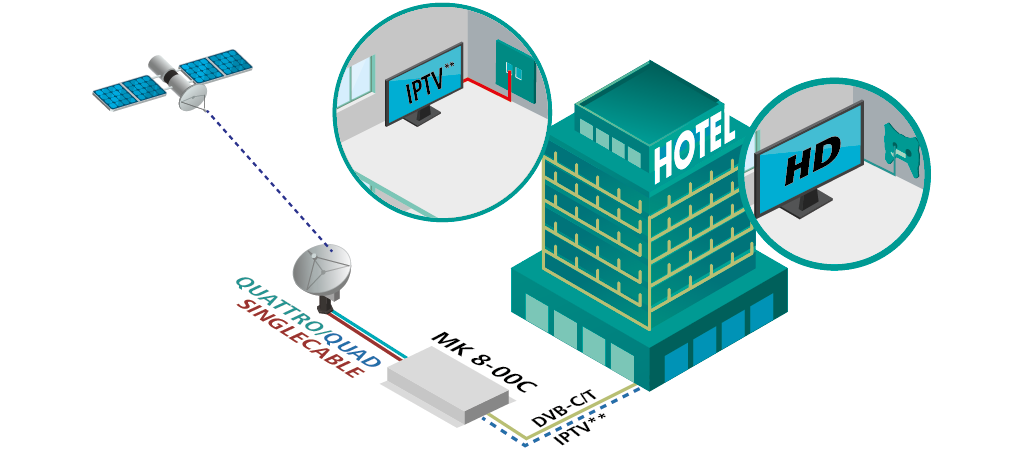
Hybrid DVB & IPTV – One Platform. Two Worlds.
- Operate Today. Upgrade Tomorrow.
The headend supports classical DVB distribution while keeping the path open for IP-based services. You can run stable RF networks now and activate IP functionality when the project requires it — without redesigning the system architecture. - Adapt to Mixed Environments
Many installations combine legacy TVs, new smart TVs, and different building sections with varying infrastructure. Hybrid technology allows you to serve all of them from a single central platform. - Scale Without System Replacement
When bandwidth needs grow or distribution models change, you expand capabilities instead of replacing hardware. This reduces operational risk and simplifies long-term planning. - Built for Transitional Markets
Not every region moves to IP at the same speed. Hybrid architecture ensures compatibility with both traditional and modern broadcast environments — making the system suitable for international projects and diverse infrastructure standards.
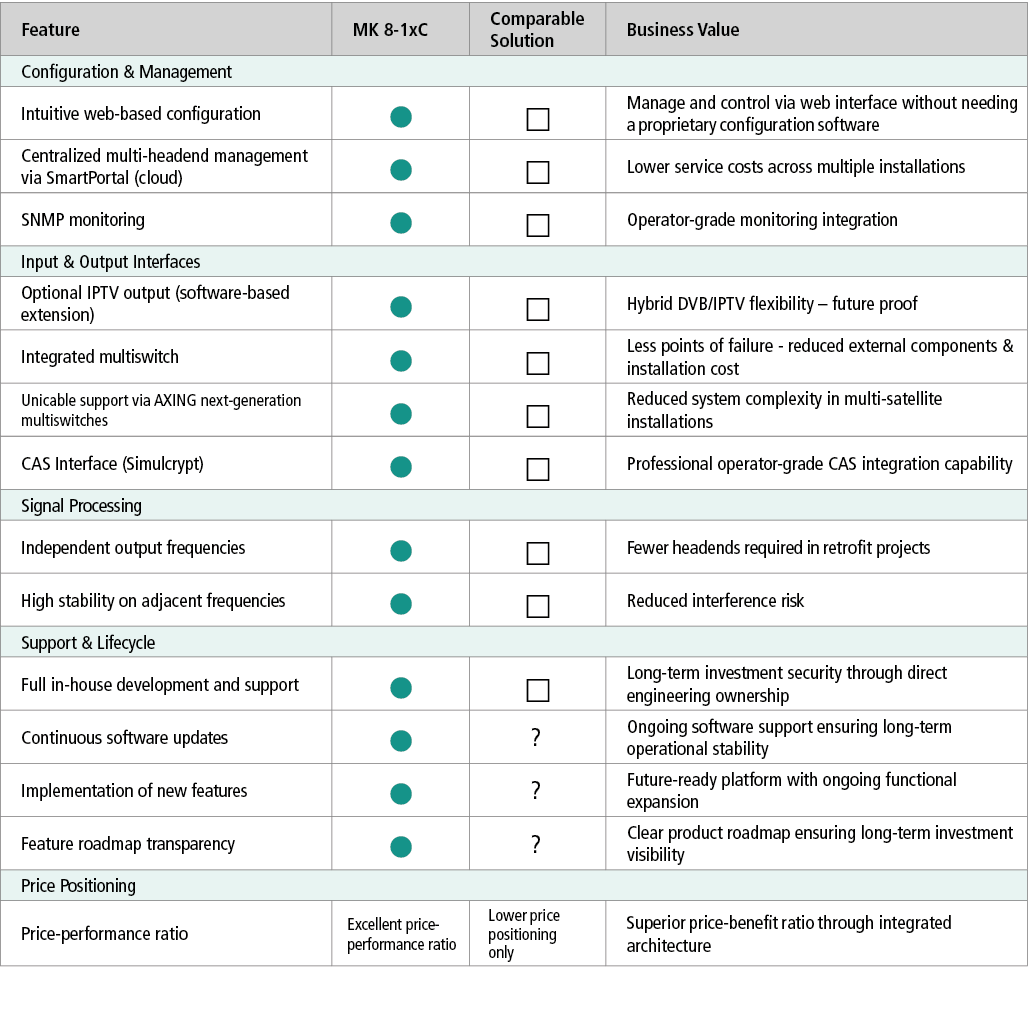
Technical & Strategic Comparison with Low-Cost Market Alternatives
How to feed AXING Headends via Single-Cable Systems
AXING Application Note
AXING headends support the reception of satellite signals via single-cable distribution systems (UNICABLE I and UNICABLE II (JESS) according to EN50494 / EN50607). This allows a headend to be supplied via a single coaxial cable.
The use of single-cable technology significantly reduces cabling efforts. Depending on the installation, the headend can receive satellite signals in various ways:
- Direct connection to a single-cable LNB
- Connection via a single-cable multiswitch
- Connection to a conventional satellite system with a quattro or quad LNB or multiswitch
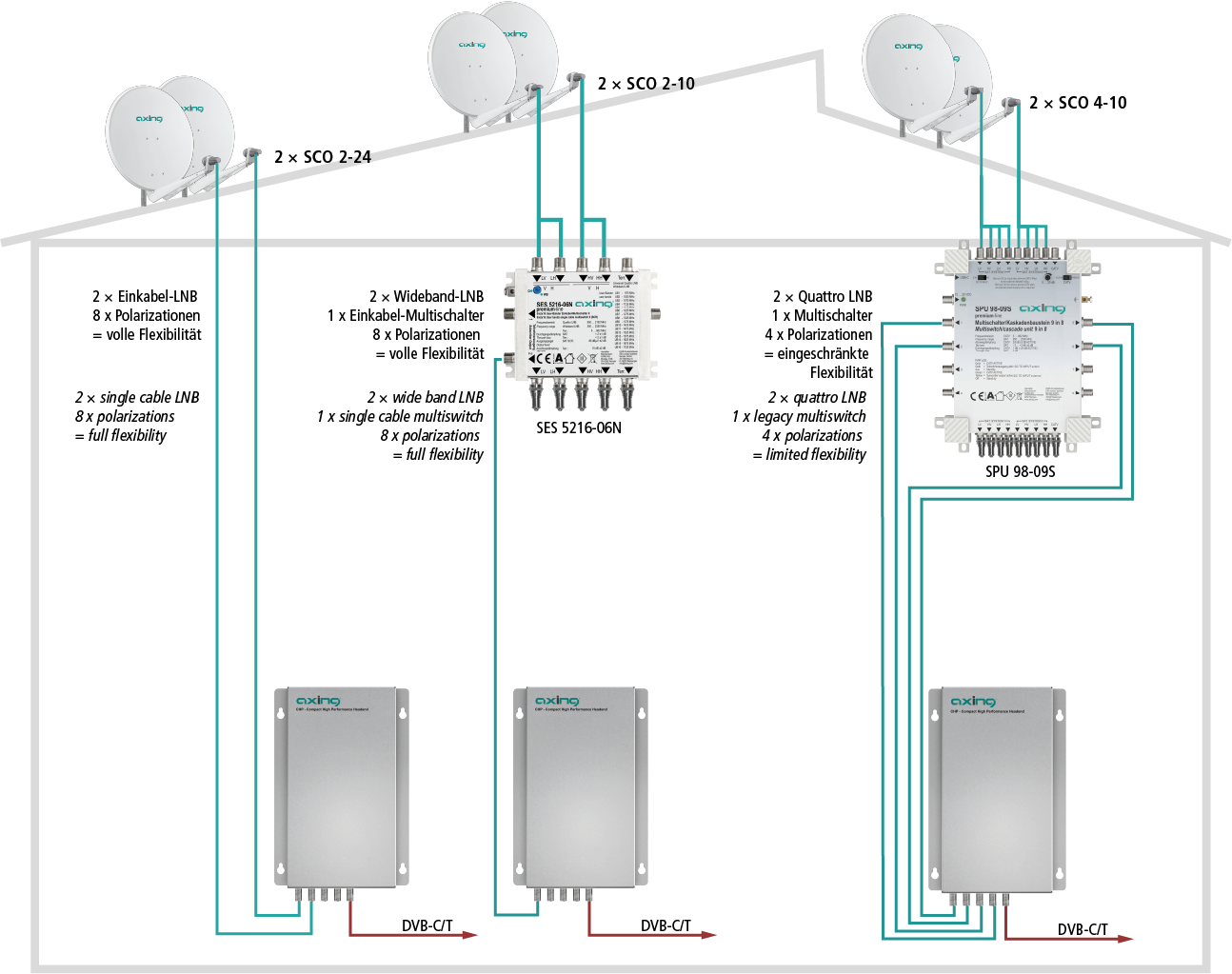
All current AXING headends support single-cable reception. The new MK-C and MK-N headend series particularly benefit from this. They have four SAT inputs and a built‑in switching matrix. In combination with a single-cable system, the headend can be supplied with all available SAT transponders via a single coaxial cable. This enables flexible system planning and reduces installation effort.
Configuration of single-cable reception
The satellite reception parameters are configured in the INITIALISATION menu of the headend user interface. The settings for the single-cable system are made in PHASE 1 – Tuner Configuration. After entering the standard transponder parameters (e.g. frequency and polarisation), only a few additional settings are required. The figure below shows an example configuration.
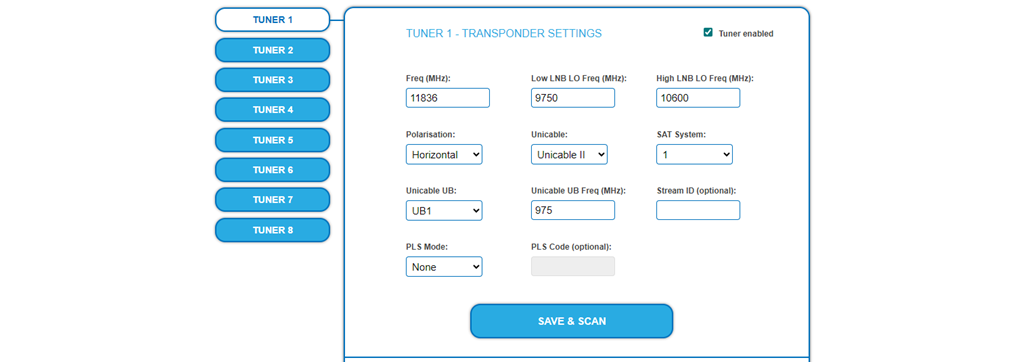
- Select Unicable II as the reception mode
- Select SAT system
- Select Unicable User Band (UB)
- Enter UB frequency according to the frequency list of the used LNB or multiswitch
- Enter desired transponder parameters such as frequency and polarisation
Installation notes
- Each SAT tuner must be assigned its own User Band (UB).
- The configured UB frequency must match exactly the LNB or multiswitch used.
- EN50607 (UNICABLE II) supports up to 32 User Bands
User Band frequency list
| UB | UB Frequency | Used in LNB | Used in multiswitch |
| UB 1 | 975 MHz | SCO 2-24 | SES 5216-06N |
| UB 2 | 1025 MHz | SCO 2-24 | SES 5216-06N |
| UB 3 | 1075 MHz | SCO 2-24 | SES 5216-06N |
| UB 4 | 1125 MHz | SCO 2-24 | SES 5216-06N |
| UB 5 | 1175 MHz | SCO 2-24 | SES 5216-06N |
| UB 6 | 1225 MHz | SCO 2-24 | SES 5216-06N |
| UB 7 | 1275 MHz | SCO 2-24 | SES 5216-06N |
| UB 8 | 1325 MHz | SCO 2-24 | SES 5216-06N |
| UB 9 | 1375 MHz | SCO 2-24 | SES 5216-06N |
| UB 10 | 1425 MHz | SCO 2-24 | SES 5216-06N |
| UB 11 | 1475 MHz | SCO 2-24 | SES 5216-06N |
| UB 12 | 1525 MHz | SCO 2-24 | SES 5216-06N |
| UB 13 | 1575 MHz | SCO 2-24 | SES 5216-06N |
| UB 14 | 1625 MHz | SCO 2-24 | SES 5216-06N |
| UB 15 | 1675 MHz | SCO 2-24 | SES 5216-06N |
| UB 16 | 1725 MHz | SCO 2-24 | SES 5216-06N |
| UB 17 | 1775 MHz | SCO 2-24 | |
| UB 18 | 1825 MHz | SCO 2-24 | |
| UB 19 | 1875 MHz | SCO 2-24 | |
| UB 20 | 1925 MHz | SCO 2-24 | |
| UB 21 | 1975 MHz | SCO 2-24 | |
| UB 22 | 2025 MHz | SCO 2-24 | |
| UB 23 | 2075 MHz | SCO 2-24 | |
| UB 24 | 2125 MHz | SCO 2-24 |